
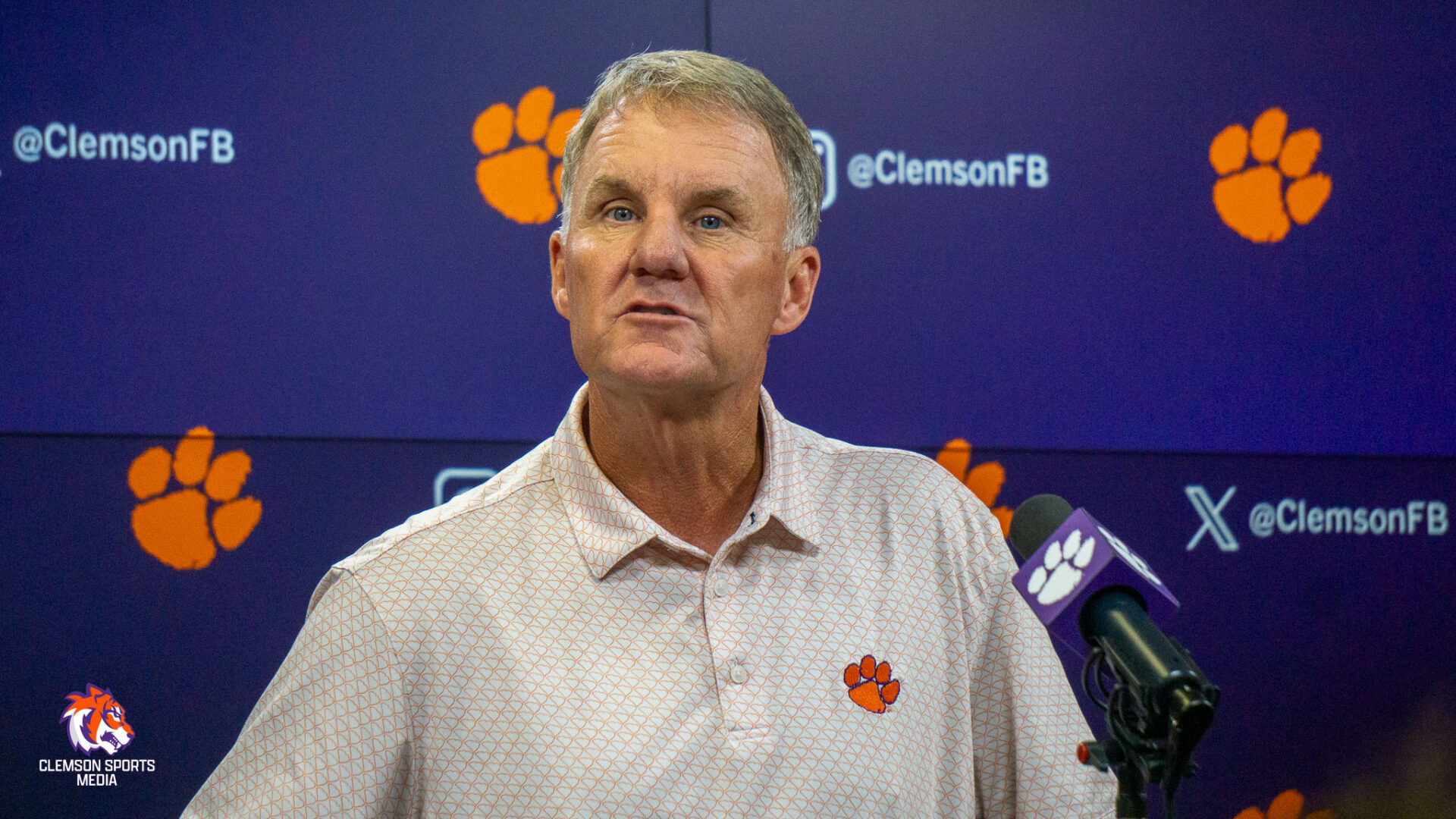
CLEMSON, S.C. — Chad Morris sounded like a man who’d been waiting a long time for Tuesday to show up. Fall camp had been long. Physical, too, by his own description. And after weeks of grinding through it, the Clemson offensive coordinator finally got to stand in front of reporters and talk about an actual opponent instead of another practice period. It’s been a few years since he last called plays here, and whatever nerves might come with that gap, he wasn’t showing them. He sounded like someone who’d been circling this date on a calendar since he took the job back.
Getting himself ready for it hasn’t been a mystery, he said. Morris spent his years away picking up pieces from other staffs and programs, visiting with coordinators around the country and pulling whatever fit into his own system. He’s brought some of that back to Clemson’s practice field in a literal way. Every period, every day, his staff runs practice on headsets, the same setup they’ll use on game day, so communication stops feeling like a separate skill and starts feeling like muscle memory. It’s a small detail. It also tells you something about how Morris thinks preparation actually works: not through one big install, but through reps that quietly turn into instinct.
The centerpiece of that preparation has been a quarterback competition that only recently resolved, and Morris didn’t pretend the process was small. Christopher Vizzina won the job, and Morris’s explanation of what changed his mind wasn’t about arm talent or command of the offense so much as something harder to coach: temperament. Vizzina doesn’t get too high or too low, Morris said, and that evenness showed up daily, not in flashes. There would be stretches during fall camp that weren’t great. There’d be stretches that were. What mattered, according to Morris, was Vizzina’s ability to wash a bad rep and get to the next one clean, a trait he called non-negotiable for any quarterback regardless of who wins the job.
The one true unknown left, Morris admitted, is the gap between a quarterback who’s been protected from contact all summer and one who’s actually been hit in a real game, a phenomenon he said Swinney has long called purple jersey syndrome. Vizzina has an edge there that a lot of first-time starters don’t: He’s taken live snaps and live hits before, which is part of why the competition took the shape it did.
It wasn’t a coronation, and Morris made sure that came through. Tait Reynolds pushed the job deep into August, and Morris brought up a stretch of practice, somewhere around a period the staff calls Jervey, where the two were nip-and-tuck enough that the decision genuinely could have gone either way. Reynolds has an arm Morris called incredible, and days blur together during camp enough that Morris couldn’t pin down the exact date things tipped. What he remembers is Vizzina responding to that pressure by staying simple and staying consistent rather than pressing to match Reynolds throw for throw.
Asked directly about a beat reporter’s question tied to comments from Dabo Swinney that Reynolds will likely see the field against LSU, Morris didn’t dodge it. Reynolds brings a talent Morris wants ready to use, he said, and whenever that opportunity lands, Reynolds will be prepared for it. Morris leaned on his own past experience coaching a player named Chandler through a similar dynamic, framing the whole competition less as a threat to team chemistry and more as a lesson in being ready to support a teammate even while trying to take his job.
Helping shape that room is a name that carries its own weight inside the building: Morris and Boyd go back far enough that Morris said they can read each other without a word passing between them, for better or worse. Boyd’s value isn’t nostalgia. It’s that he’s played quarterback at Clemson at a high level, and he can speak to what Swinney expects from that room in a way nobody else on staff can duplicate. Morris also credited analyst Trent Perman for bringing a similarly even-keeled, detail-oriented presence to quarterback meetings, comparing his role to what Donnie McLean provided years ago when Boyd himself was still playing. It’s not one voice running that room. It’s a stack of them, each adding something different, and Morris was explicit that he sees it that way rather than crediting any single name.
That same layered structure shows up on game day itself. Mike Miller works from the coaches’ box and has become, in Morris’s telling, someone with a real feel for what’s coming before it happens, a skill he called rare among coaches. Brad Glinn and Freddie Kitchens, both former offensive coordinators elsewhere, sit up there, too, and Morris said he leans on both of them regularly, sometimes taking an idea, sometimes politely setting it aside for his own plan. Carson Kramer works the box alongside offensive line coach Luke, keeping that communication tight.
Morris himself stays on the sideline rather than climbing to the box, a deliberate choice. He wants his quarterback, and honestly his entire offense, to be able to see him and feel his urgency in real time, whether that means picking someone up after a bad series or settling them down before the next one.
Morris hasn’t had much time with the receiver room compared to other position groups, since none of that unit went through spring practice with him. What he’s seen on tape and in fall camp has him talking about T.J. Moore and Bryant Wesco Jr. in the same breath as the wide receivers who’ve defined Clemson’s offense for years, with Tyler Brown pushing for real reps behind them. Moore’s connection with Vizzina on deep balls hasn’t gone unnoticed inside the building, and Morris was careful to note that none of those jobs are settled just because camp is over. Swinney’s line about there being no such thing as a starter applies here, too, Morris said, and there’s a group of younger receivers behind the top names pushing hard enough to make sure of it.
Up front, Morris was about as direct as he got all morning. The offensive line group has carried fall camp, he said, establishing a standard of toughness the rest of the offense had to match. Credit for that goes to offensive line coach Luke and Kramer, both of whom Morris said made sure the room’s standard never softened even as new faces filled it. It’s a unit Morris described as tightly bonded, and given how much turnover hit that group this offseason, that cohesion matters more than usual heading into a hostile environment in Baton Rouge.
Underneath all of it is a story about Morris himself, and he didn’t shy away from telling it. He was on staff here in 2011, left, built a career elsewhere and came back to find the standard exactly where he’d left it. Best is the standard, he said, echoing the same phrase Swinney has preached daily since before Morris’s first stint ended.
Playing or coaching at Clemson, in Morris’s words, comes with a duty to ride for the Tiger Paw and everyone who bled and broke bones for it before him. He credits his entire coaching career to Swinney, calling him a mentor, a boss and a friend in the same breath, and said it took actually leaving to fully appreciate what he had. He compared it, almost offhand, to the old Blue Bell ice cream tagline about the glory days happening right now. Consistency was the word he kept returning to, not just for his quarterbacks but for how his own staff recruits, plans and runs meetings.
The one area Morris stayed guarded on was tempo. He’s evolved from a coordinator who used to play fast on nearly every snap into one who picks his spots, and when a reporter pushed on exactly when those tempo decisions get made, Morris laughed the question off rather than tip anything with the opener closing in.
Whatever that evolution looks like at kickoff, in front of a hostile Tiger Stadium crowd with a first-time starter under center and a true freshman waiting for his own shot, is about to get tested in a way fall camp never could. And speaking of that crowd, the defense Tom Allen is preparing on the other side of the ball is walking into the exact same unknown.


