
Clemson’s offensive line has quietly put on weight for three straight years, and that’s not an accident. It’s a plan.
Look at the roster numbers and the pattern jumps off the page. From 2017 through 2022, Clemson’s offensive line lived in a tight band, averaging somewhere between 301 and 305 pounds a man, year after year, regardless of who was starting. Then 2023 hit, the number climbed to 308, and it hasn’t come back down since. By 2025 the group averaged 312 pounds, the heaviest offensive line Clemson has fielded this decade. Not roster noise. A program deciding, on purpose, what kind of offensive line it wants to be.
The timing matters, but not in the way it looks at first glance. Thomas Austin took over the offensive line room in 2022, and by his second season in 2023 the group’s weight had jumped to 308. That November, Clemson fired Austin and hired Matt Luke who had be at Ole Miss and Georgia to replace him. The number didn’t reset. It held at 306 in Luke’s first year, then climbed to a decade-high 312 in his second. Two different coaches, one trend line that never actually broke.
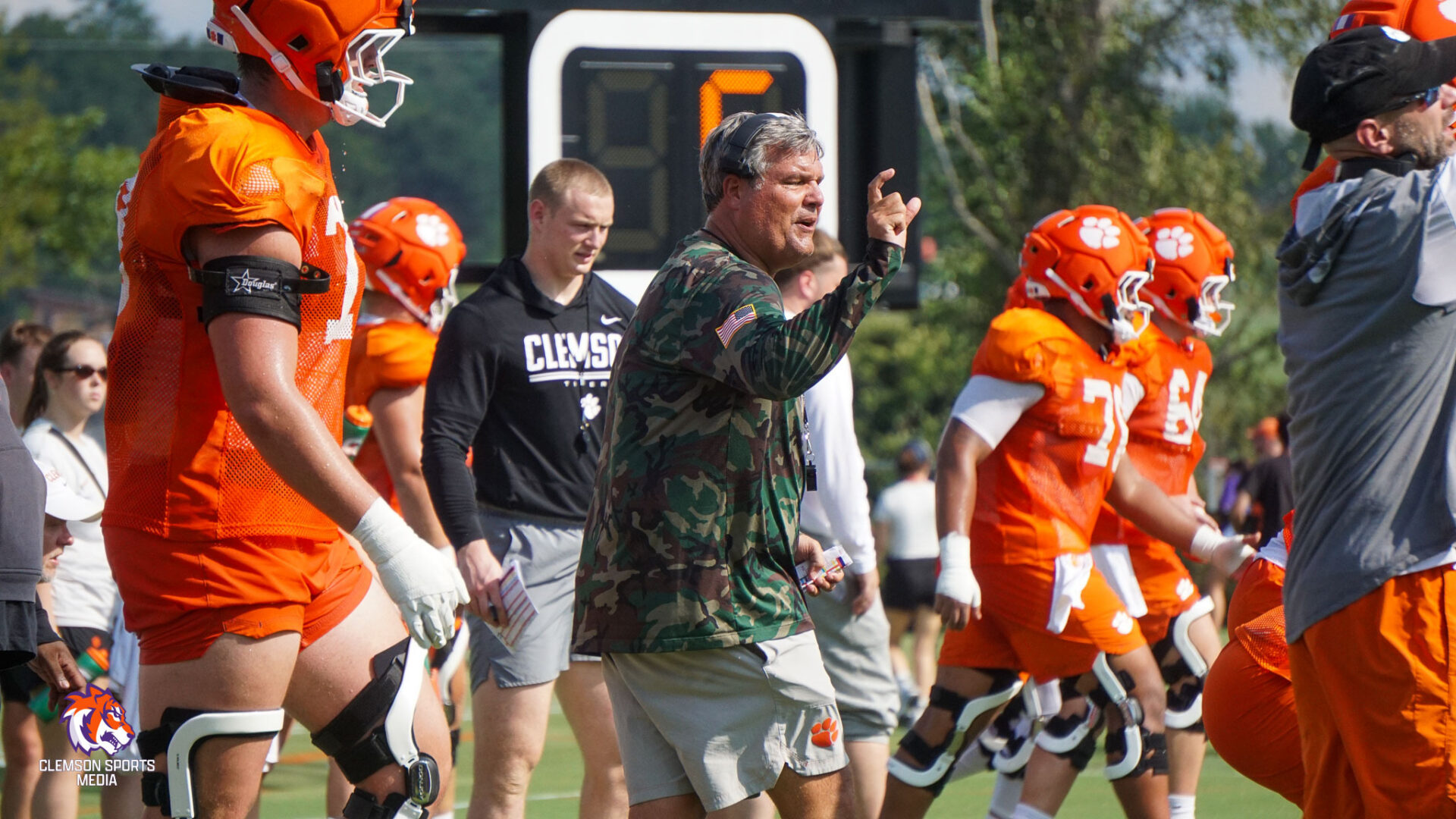
Now pair that history with how Luke, the coach who inherited that number and kept pushing it, has described his philosophy for the room this spring. He frames the group as one unit rather than five separate parts, a line that has to move and finish together instead of five talented individuals doing their own thing. He’s been blunt about his job description too: get the best five guys on the field, period. Not a coach chasing one player’s max bench or his 40 time. A coach building collective mass and a shared identity up front.
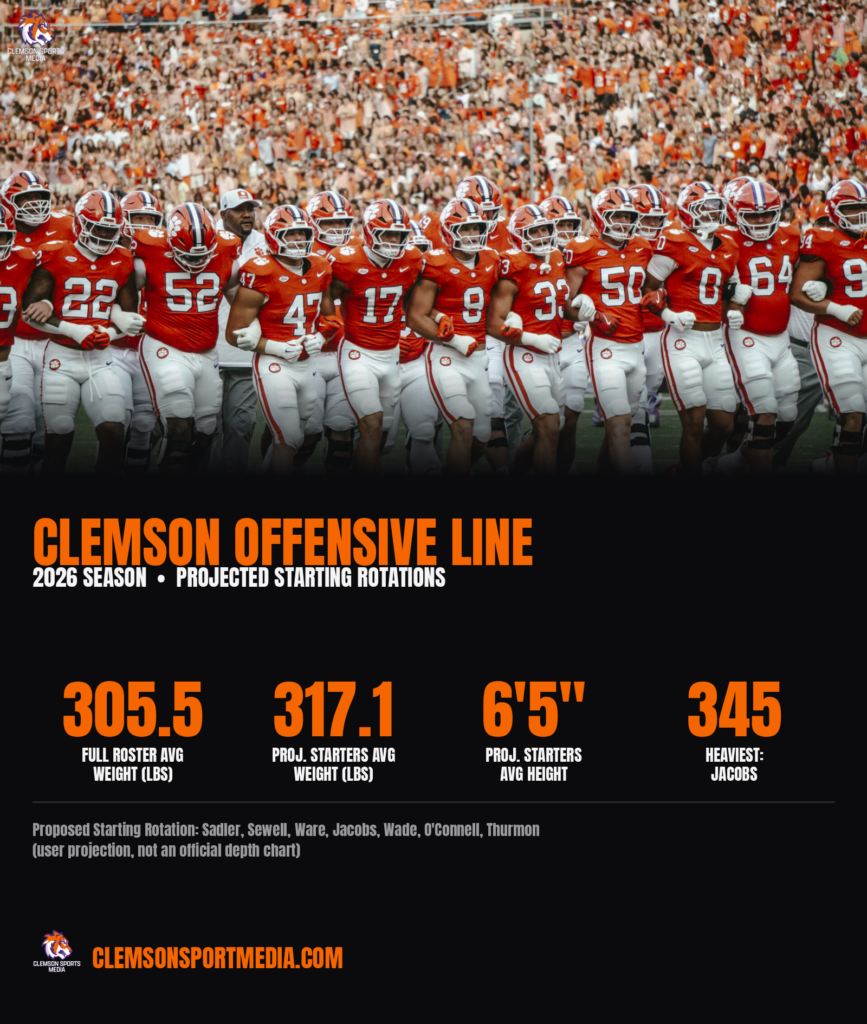
Read Clemson’s 2026 roster with that lens and the picture gets sharper. Dominic Cardone is the extreme case, 6’9″ and 385 pounds, the tallest and heaviest lineman Clemson has rostered this decade. Brayden Jacobs isn’t far off at 345, and Elyjah Thurmon, a projected starter at guard, carries 325 on a 6’4″ frame. Ronan O’Connell, another likely starter, rounds out the group at 320. Add it up: a full 20-man room now averages 305.5 pounds, and a realistic starting five projects closer to 314 to 317 a man. Heavier than anything Clemson trotted out under Dabo Swinney’s earlier offensive line regimes.
Here’s where the opinion part comes in, because the weight alone doesn’t win football games. What makes this bet defensible is that Luke isn’t building size for the sake of size. He’s building it inside a structure that treats the whole group as a single organism. That’s the difference between a heavy offensive line that gets bullied by speed and a heavy offensive line that mauls people in the run game because everyone up front is playing the same style at the same weight class. Clemson lost four starters off last year’s group. Instead of leaning on returning experience to hold the line together, Luke leaned on collective mass and a competition-first camp to replace it. Every spot on that line was open. Every player knew somebody could take his job by Friday. This isn’t a rebuilding posture, it’s a program trusting its size and its system enough to let the best five sort themselves out, position by position, regardless of who started the year before.
But a line this heavy has to move. Clemson’s offense operates under new offensive coordinator Chad Morris, whose track record is built on tempo, on wearing defenses down by lining them up over and over without a chance to substitute. Historically, tempo offenses and 345-plus pound guards don’t always mix. Heavier bodies gas out faster in an up-tempo system. If this group can’t sustain Morris’s pace, all that added beef turns into a liability by the fourth quarter instead of an asset.
That tension is real. It’s also exactly why the size increase reads like a calculated bet, not a blind one. Luke has stocked the room with players who can handle it. Collin Sadler and Thurmon can both line up at multiple spots. That means Clemson can rotate bodies through a tempo-heavy game plan instead of asking one guy to play every snap at 320-plus pounds. Harris Sewell’s move to center adds another smart, athletic body in the middle, right where tempo offenses need the fastest communication and the quickest reset between snaps. Luke isn’t just adding pounds. He’s adding pounds to players who’ve shown they can still move, communicate, and rotate inside a scheme built for speed.
That’s the case for betting on this group. Clemson’s fall camp reps back that up, and the group isn’t getting heavier at the expense of the identity Morris wants to build. It’s getting heavier because a coaching staff decided that a mauling front, applied consistently by a unified group rather than five guys doing their own thing, is the foundation the rest of the offense needs to run behind. The results of that bet will show up in short-yardage conversions, in how often Clemson’s running backs get moved off their spot before the second level, and in whether this group is still finishing drives in the fourth quarter of ACC games in November.
Clemson has rebuilt an offensive line from scratch before. What’s different this time is that the program isn’t just replacing bodies, it’s replacing them with bigger ones, on purpose, inside a culture built to make that size actually mean something. That’s a bet worth watching play out.


