
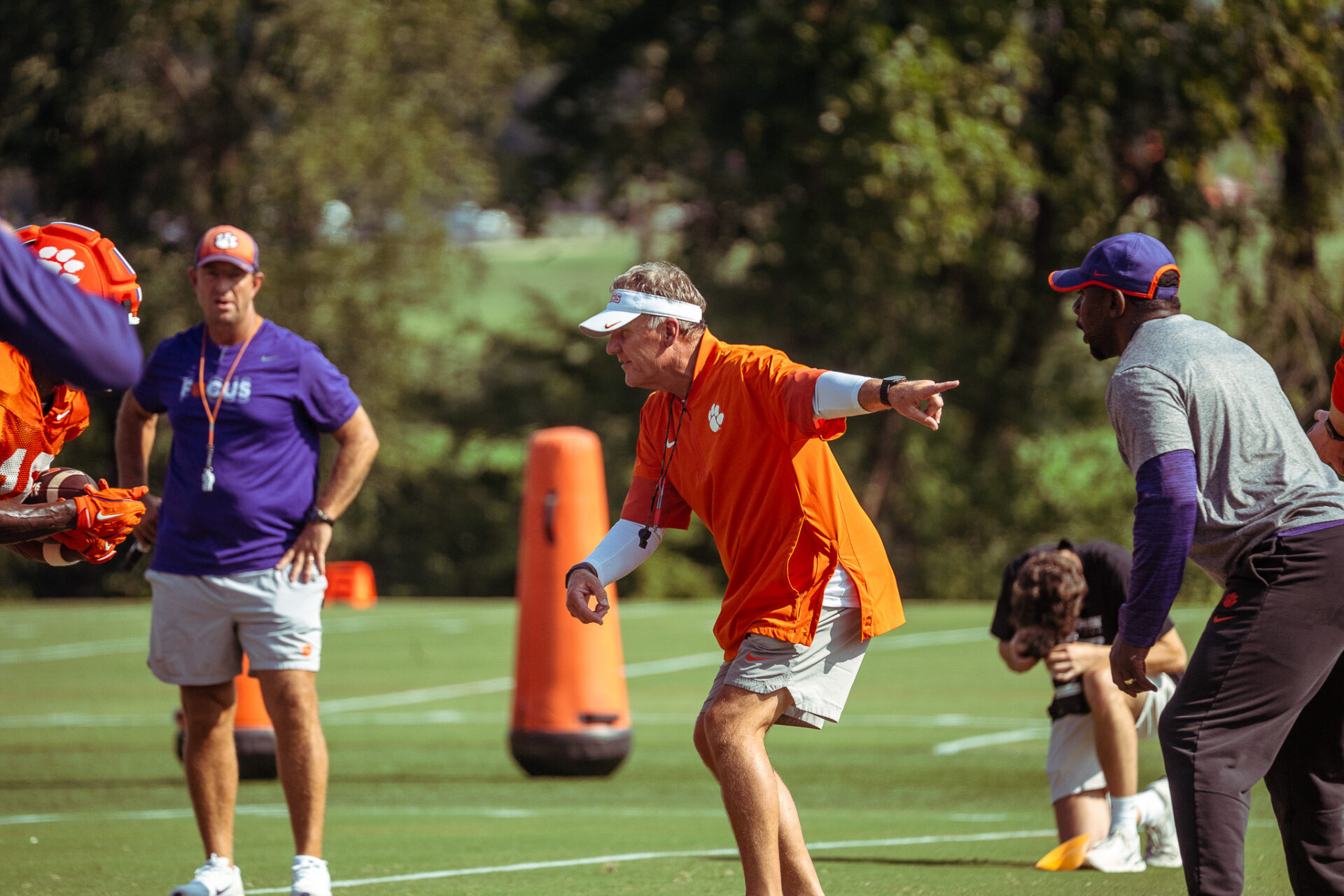
The heat sits on Jervey Meadows like a wet blanket most August afternoons, the kind of South Carolina swelter that turns a routine practice into a conditioning test nobody signed up for. Clemson’s offensive linemen don’t get a say in that. They just line up, snap the ball, and go again. And again.
Chad Morris has been running that tempo since he walked back through the door this offseason, and if you believe his own hype, it’s the best he’s felt about a Clemson offense in years. “I’m as pumped up as a bike tire right now,” Morris told reporters this week, a line delivered with the kind of grin that made it clear he meant it. He talked about Red Bulls and Fruit Loops. He talked about the program he loved being worth coming back to. And he made one point that mattered more than the rest. The version of his offense that shows up against LSU in a few weeks won’t be the same one Clemson fans remember from a decade ago.
“The last time I was here it was all about tempo, tempo, tempo,” Morris said. “But now defenses have caught up to that.” Execution, he explained, still decides everything. Speed is a tool now, not the whole plan.
That’s easy to say in a press conference. It’s a different thing to hear it independently from the guys snapping the ball into his hands every day.
Ask Brayden Jacobs what’s changed about this offense and he doesn’t start with schemes or install packages. He starts with mindset. “Coach Morris is awesome,” Jacobs said. “His sense of humor is higher than other coaches I’ve seen. But I think his offense is just a really special thing. If all 11 guys give their all their effort, even if some guy messes up, it’s still special. It’s definitely changed the way our mindsets have been going into the fall.”
That’s the piece the highlight-reel version of Morris skips. It’s not just about tempo and Red Bulls. It’s a scheme built so one missed assignment doesn’t sink a play, so long as everyone else does their job. Jacobs, one of the veterans anchoring Clemson’s line, has taken on a mentor role with the younger guys this camp. He credits last year’s leaders, Tristan and Blake Miller, with teaching him that leadership only means something when your effort backs up your words. Now he’s the one preaching it. And what he’s preaching sounds a lot like what Morris is selling.
Elyjah Thurmon backs it up from a different angle. Ask him about Morris and the first word out of his mouth is energy. “Coach Morris is intense every day,” Thurmon said. “He brings juice every single day. There’s no way you could come out to practice and feel lackadaisical or feel un-energized because he comes out on 100 every day.” Thurmon isn’t just talking about vibes, either. He ties that daily intensity directly to what’s showing up on the practice field: a run game the whole offensive room has bought into. “We’re going to be a team that runs the ball,” he said, “so we need to be physical in the run game and all phases.”
That’s not a small shift. For an offense that’s carried a reputation for chasing explosive plays through the air, hearing the offensive line frame this year’s identity around physicality in the run game says something about where Morris is actually pointing his group, regardless of what gets said at the podium.
It’s not just the trenches saying it, either. Running back Chris Johnson Jr. described his own adjustment to Morris’s offense with a word that echoes straight back to the coordinator’s own press conference. “Playing in Chad Morris’s offense, it’s tough,” Johnson said, “but it’s tempo. It’s fast. Everybody’s got to play fast. It’s hot right now, so everybody’s trying to get acclimated with the heat, but that’s what we run.” He’s been through it since spring practice, and he’s not sugarcoating how hard the adjustment has been. But there’s no daylight between his description and Morris’s own words about tempo. Different voice, same story.
Johnson also touched on something Morris hinted at without saying it outright. He wants the ball in the hands of skill players, out in space. Asked if Morris wants the ball in the hands of his playmakers, Johnson didn’t hesitate. “That’s a part of my specialty, yeah,” he said. “I definitely enjoy my playing style, what I bring to the table.” Wheel routes, checkdowns, backs split out wide. It’s the modern-tempo version of Morris’s offense, not the one that lived and died on pace alone a decade ago.
And then there’s Dabo Swinney, who’s watched Morris’s offenses up close longer than anyone else in that building. Is this year’s group playing the old classic uptempo Morris style? Put that question to Swinney directly and he didn’t give a yes-or-no answer. He gave a breakdown.
“It’s a combination,” Swinney said. “There’s certain times where you feel like you got them on their heels, and you’re going to really use the tempo to your advantage. And there’s other times where you want to slow it down and change the cadence. You might look like you’re going fast, but you’re going slow. You might look like you’re going slow, but you’re gonna go fast. It’s a rhythm to it, the instincts of when you go fast, when you try to go fast but slow it down, or when you play at a normal tempo. He’s got a great feel for that. He’s done a great job. Great job, the whole staff.”
Swinney made that point right after praising Jacobs and Sadler by name for the depth they’re creating up front, a detail that ties the head coach’s read on the offense directly back to the same players describing it from the inside. Morris said the pure-speed version of his old offense has been solved by defenses. Swinney is describing exactly that adjustment, a group that can change gears on purpose instead of running one setting into the ground. Jacobs is describing a scheme that survives individual mistakes because of collective effort. Thurmon is describing daily intensity that’s translating into a heavier run-game identity. Johnson is describing a tempo demand that matches what Morris himself called out in his own press conference, word for word almost.
None of those four were in the room when Morris talked about bike tires and Fruit Loops. They didn’t need to be. What they’re describing independently, from three different position rooms, lines up with what their coordinator said about himself almost exactly.
That’s the part worth paying attention to heading into a season opener against LSU that will put all of this under a microscope fast. Coaches sell energy every August. Fans have learned to be skeptical of it, and for good reason. But when the offensive line is describing a scheme that survives mistakes through full-unit effort, when a running back is echoing his coordinator’s own language about tempo without prompting, and when the head coach is independently confirming the tactical evolution Morris claims he’s made, that’s not just camp hype anymore. That’s a program’s private read on its own offense matching its coordinator’s public one, piece by piece.
Clemson has heard “we’re different this year” before. What’s different this time is how many separate voices are saying the same specific thing, without being asked to agree with each other.


