

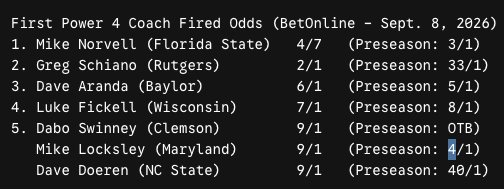
Following Clemson’s 51-10 blowout loss to LSU in Week 1—the most lopsided defeat of Swinney’s head-coaching tenure—BetOnline added Swinney to its “First Power 4 Coach Fired” board at 9/1 odds (fourth-highest) after being off the board in late August.
However, any administrative desire to move on from the two-time national champion collides directly with one of the most coach-friendly contracts in college sports.
Contract Breakdown & Buyout Specifics
Swinney signed a 10-year, $115 million contract extension in 2022 that runs through the 2031 season.
Rubbing the Rock
- Firing Without Cause Buyout: If Clemson terminates Swinney without cause during the 2026 season, the university owes him a flat-rate buyout of $57 million.
- No Mitigation/Offset Clause: Unlike typical coaching contracts, Swinney’s agreement contains no duty to mitigate. If Clemson fires him, the school must pay the full $57 million balance regardless of whether Swinney takes another coaching job or broadcasting role.
- Buyout If Swinney Departs Voluntarily: Should Swinney resign to take another head coaching job in 2026 or 2027, he would owe Clemson $3 million.
- The “Alabama Clause”: If Swinney leaves Clemson specifically to take the head coaching job at Alabama, his buyout fee increases by 150%, raising his buyout obligation to $7.5 million.
Betting Board & Prediction Market Realities
While oddsmakers adjusted Swinney’s hot-seat profile after Week 1, prediction markets highlight the financial buffer protecting his position.
On event-contract prediction platforms like Kalshi, traders price the likelihood of Swinney leaving or being fired before Dec. 1, 2026, at just 1%. Market analysts attribute the low probability directly to the $57 million lump-sum requirement and the absence of offset relief for Clemson boosters.
The On-Field Catalyst
The financial discussion re-emerged after LSU outgained Clemson 644 to 145 in total yards and logged 38 first downs to Clemson’s 8 in the season opener.
The defeat marked Clemson’s largest margin of loss since 2000 and compounded concerns following a 7-6 finish in 2025—the program’s worst season since 2010. Since the start of the NIL and transfer portal era, Clemson has compiled a 47-21 record while Swinney’s persistent refusal to utilize the portal continues to draw national criticism.


