
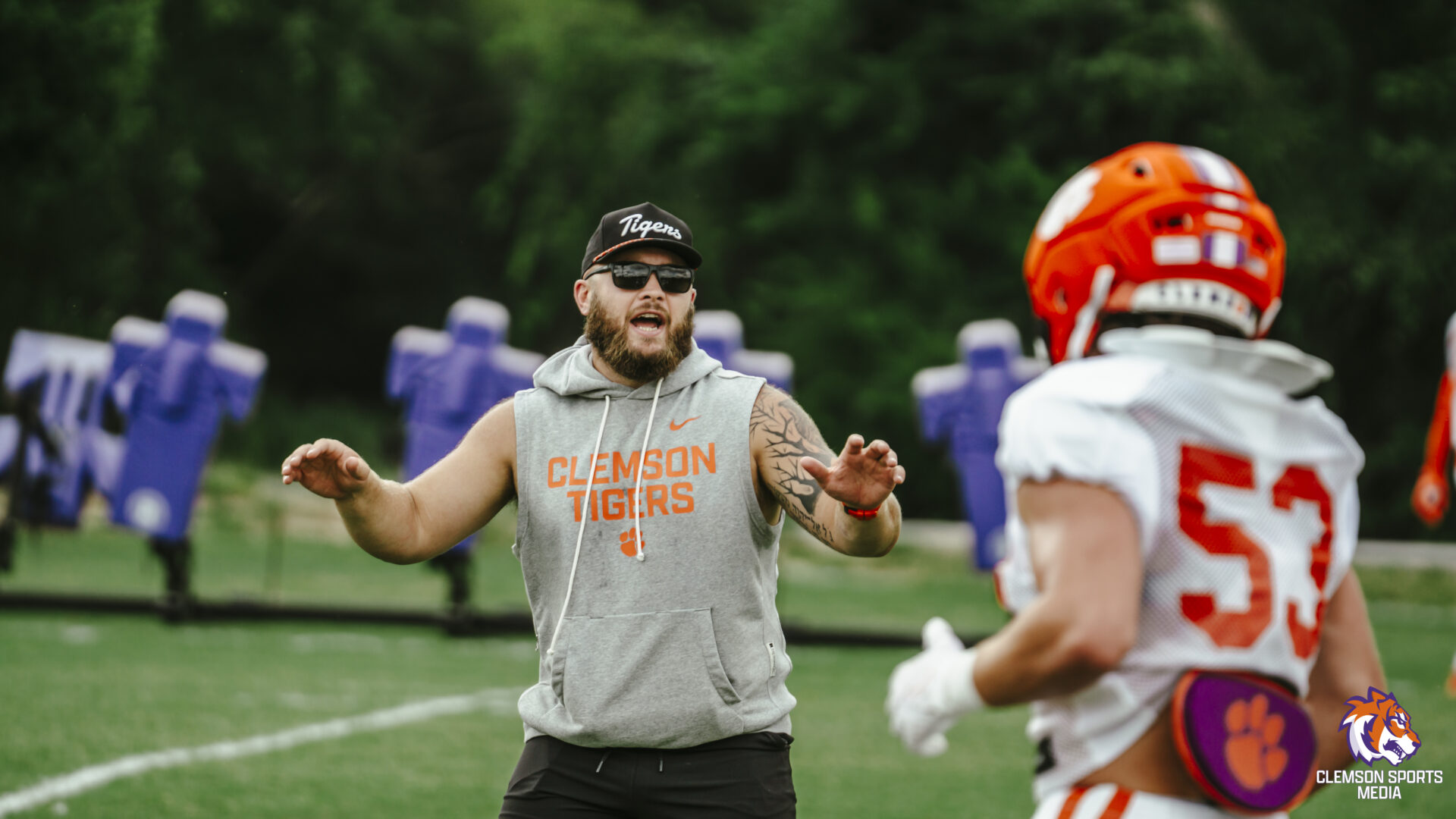
Ben Boulware knows exactly what it looks like when a young linebacker skips the hardest part of the job. It looks like silence at the worst possible moment, and this summer, he’s made it his mission to make sure Sammy Brown doesn’t get away with it.
The transition happened quietly, but it’s the thing Boulware keeps coming back to when he talks about what this fall camp actually needs to accomplish. Wade was the guy last year, the alpha, the one everybody leaned on to be the rah-rah voice and the challenger in the room. “That was Wade’s responsibility to be the alpha, the rah-rah guy, the challenger, because he’s the old head and he had the most experience,” Boulware said. Wade, in his description, was a run-through-a-brick-wall type, ready to fight anybody who disagreed with him. Sammy is not that. “Sammy is dean’s list, biology major, yes sir, no sir,” Boulware said, and that’s not a knock. It’s a different kind of leader, which means it takes a different kind of coaching to get there.
“It’s my responsibility to understand how to communicate with each guy and how to lead each guy, because they are different,” Boulware said. “It’s not cookie cutter.” He wasn’t trying to turn Wade into a copy of himself last year, and he’s not trying to turn Sammy into Wade now. The job is making Sammy the best version of Sammy, which this summer has specifically meant handing him the reins of communication and then holding him to it, hard.
That played out in a real moment Boulware described from this offseason. Sammy and the linebacker group were out running the Dike Runs when nobody communicated or challenged anybody the way Boulware wanted. He texted Sammy afterward. Sammy called him back immediately. “I was like, this is going to be the area that I cuss you out most, is like communication and holding guys accountable,” Boulware said. Sammy’s response, in Boulware’s telling, was almost disarmingly honest: sometimes he just doesn’t know how to do it. That’s fine, Boulware said. Figuring it out is the whole point of camp.
Boulware doesn’t think leadership is one thing. He breaks it into three levels: a player holding himself accountable and working hard because he wants to, a coach challenging players and holding them to a standard, and then the hardest one, players holding each other accountable without a coach in the room to make it happen. That third level is where he says most locker rooms actually live or die, and it cuts against something real about coaching twenty-year-olds. Calling a teammate out is uncomfortable at that age. So is the opposite move, actually telling a guy he did something well. “A lot of guys need that,” Boulware said. “That’s one of the things I try to be better at.” He traced it back to his own playing days, getting his tail chewed by Brent Venables and loving the man anyway, and the lesson he took from it: there’s a time and place for tearing a guy down, and that window is small, usually private, and one-on-one. The rest of the job is encouragement.
Not every linebacker in that room needs the same push. Jeremiah Alexander and Fletcher Cothran, Boulware said, already communicate naturally, and the whole locker room respects both of them for it. Cothran in particular has a story worth knowing: a walk-on who earned his scholarship, then got into a bowl game and recorded a sack on the first play he saw. He had a good spring behind that, and Boulware, who shares a high school with him at T.L. Hanna, is expecting a big year out of him, with the obvious caveat that he still has to earn it in camp. Sammy and Kobe McCloud are wired differently, quieter by nature, and Boulware has had to lean on them harder to get the same result. His method last year with Wade was blunt: when a younger player came in alongside him, Boulware would tell Wade flatly not to say a word, forcing the newer guy to communicate on his own. He’s using the same trick now with Sammy, planning to go quiet on him mid-rep so whoever’s standing next to him has to set the front himself instead of waiting for Sammy to handle it.
McCloud gets a different kind of note entirely, because Boulware sees a lot of himself in him. Neither of them was ever going to be the fastest or biggest guy on the field. “We’re the six-foot dudes that are undersized, that are not going to be a burner,” Boulware said. “They got short arms, but like, make plays.” His job with McCloud isn’t fixing what he can’t change physically. It’s making sure McCloud plays smart enough, and communicates well enough, that the physical gap never shows up on Saturdays.
Then there’s Jeremiah Alexander, whose challenge is almost the opposite of the communication question. Alexander is a natural talker and already fully respected in that locker room for how hard he works. What he’s still building is comfort in a body he hasn’t played in for very long. He came up almost entirely as an edge player, and dropping into an off-ball linebacker spot means learning run fits and reads he simply never had to learn rushing the passer. Boulware says he made real progress this spring and expects more of it this fall, but it’s a legitimate transition, not a switch that flips overnight.
All of it sits inside a bigger structural demand coming from coordinator Tom Allen, who wants something close to one in four linebackers able to play all three spots in the room: Sam, Mike, and Will. It’s not new. Alexander and Cothran both had to learn all three a year ago, and Wade and Sammy were drilled on the other’s role too, in case a third-down package called for a swap. Boulware isn’t backing off that standard now that the room has turned over. Guys who know multiple spots are simply more available, he said, and there’s a coaching benefit buried in it too: players tend to grade out more consistently when they understand what the guy next to them is supposed to be doing, not just their own job.
Some of what’s changed in that room has nothing to do with scheme at all. Boulware talked about the green dot communication technology now built into practice, the in-helmet system that lets one designated player hear play calls in real time, and he called it a legitimate game-changer compared to the way linebackers used to have to set fronts and run checks entirely off memory and eye contact. It’s not without its own coaching wrinkle. Boulware said he’s still working out the balance between giving a player useful information through that channel and simply overloading his brain with more than he can process live.
Boulware is also being honest about his own growth as a coach. He talked about becoming more comfortable in Tom Allen’s scheme and expectations, and more comfortable finding the line between being a coach these players genuinely like and still being the guy in the room they answer to. He told a specific story about correcting Sammy for calling him “bro” in front of the group, not because it bothered him personally, but because a team meeting isn’t the place for it. A one-on-one phone call, when Sammy’s just looking for advice, is a different matter entirely, and Boulware said that exact thing happened again just last week.
The season behind all of this hangs over the whole conversation, whether Boulware is asked about it directly or not. Clemson finished 7-6 a year ago, and he’s not interested in pretending that didn’t sting. He drew a direct line to his own playing career, specifically the fire that followed Clemson’s national championship game loss heading into the 2016 season, the year the Tigers won it all. A bad season and a heartbreaking near-miss aren’t the same kind of pain, in his telling, but they motivate the same way. “Both those things motivate you and piss you off,” he said. The approach from here is simple in theory and hard in practice: acknowledge exactly what went wrong, fix it, and stop relitigating it once the fixing is actually happening.
Part of that fix, in Boulware’s eyes, is sitting one building over in the weight room. He didn’t hesitate when asked about new strength coach Dennis Love, and the answer he gave doubled as a story about the whole locker room’s reaction the day Love got the job. “The best indicator of the guys’ opinion on D-Love is when Coach Swinney announced it, the boys went wild,” Boulware said. That kind of buy-in matters more than it might sound like from the outside, because Love inherited a locker room that deeply respected Joey Batson, and Boulware said the transition has been seamless specifically because guys trust Love the same way. He’s not selling that trust as universal daily affection. “There’s plenty of days where the guys aren’t gonna like D-Love, but they respect him and they listen to him,” he said, adding that most of the room probably wouldn’t say they love the process on any given morning even if they respect what it’s building.
What it’s building, in Boulware’s telling, is depth that shows up on fourth-quarter snap counts, not just a roster that looks fast in shorts in July. He brought up a specific memory from his own playing days to make the point concrete: a game against Louisville during the 2016 season when Clemson didn’t have the depth it needed and Boulware played 108 snaps himself. “It’s awful,” he said. “It’s just different, dude. You gotta have a good engine.” He described Love’s program as an old-school and modern approach stitched together, hill work and longer conditioning blended with shorter, high-intensity anaerobic sprints, built specifically so Clemson can survive a twelve- or fourteen-play drive without the defense falling apart late.
None of what Boulware described is a finished product. Sammy Brown is still learning when to speak up, Jeremiah Alexander is still learning a new position, Kobe McCloud is still figuring out how loud he needs to be to make up for what his body won’t give him physically, and Boulware himself is still learning how to be a leader players both like and answer to. But the throughline in everything he said is that Clemson isn’t hoping any of that resolves itself. It’s coaching it, deliberately, one uncomfortable phone call at a time.