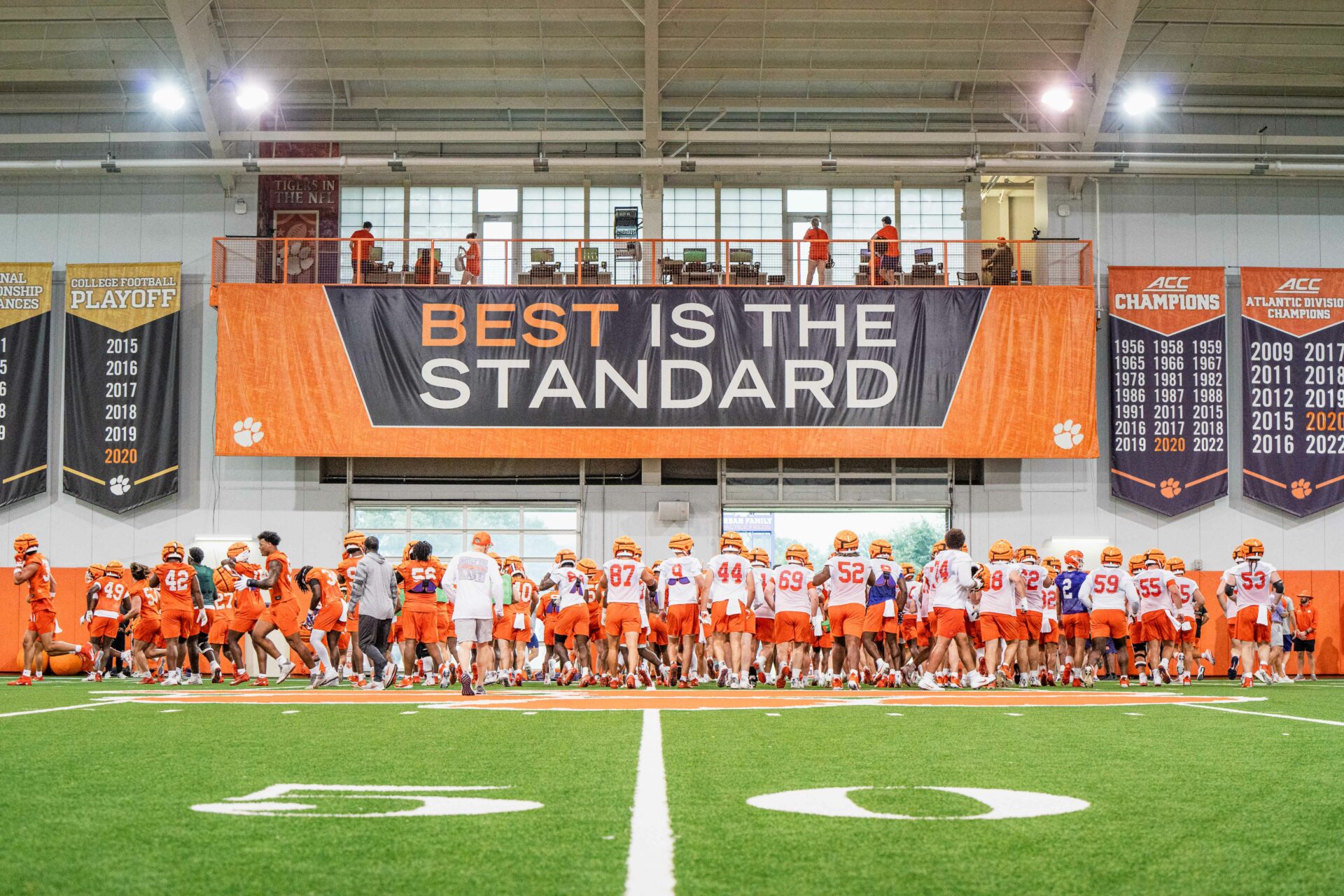
CLEMSON, S.C. — Every offseason produces a version of this story. A program comes off a year that didn’t go the way it wanted, a coach stands at a podium and talks about getting back to where the program belongs, and everybody nods along because that’s what July is for. Clemson has spent this entire offseason telling that story. The difference this year is how much of it is actually checkable. Let’s checkout what Clemson Reset season actually means.
Start with the record itself, because it’s the thing every other decision this offseason traces back to. Clemson finished 2025 at 7-6, the kind of season that felt considerably longer than its win total, and Dabo Swinney has made no attempt to dress that up. He’s called it done, moved past, buried. That’s easy to say in July. What’s harder to fake is everything Clemson actually did about it, and that’s where this offseason stops looking like standard-issue coach-speak and starts looking like an actual plan.
The plan has three parts, and each one is a real, separate bet.
The first bet is on culture, and it starts in the weight room. Joey Batson ran Clemson’s strength program for almost thirty years, since 1997, long enough that changing it at all was a genuine decision rather than a formality. Dennis Love has that job now, and he’s spent his first offseason doing something more specific than tightening standards. He brought back the Dike Runs, a hill-sprint tradition that had quietly disappeared, and turned the weight room into something closer to a gathering space with late-night squat parties built on neon lights and shared misery. None of that is decoration. It’s an attempt to rebuild a locker room’s relationship to hard work from the ground up, and Swinney’s own language backs that up. He’s spent the offseason insisting this team is faster at literally every position than the one that stumbled to 7-6. That’s not an opinion. It’s a claim that either shows up on tape by October or gets thrown back in his face by November.
The second bet is on the roster itself, and it’s the loudest one. Clemson brought in nine new pieces through the transfer portal this offseason, the heaviest single class the program has ever run, which tells you something Swinney hasn’t had to say out loud: internal development alone wasn’t going to fix what went wrong last year. That kind of portal dependence is an admission as much as it’s a strategy. It also runs headfirst into the biggest structural problem on the roster, an offensive line that lost four starters at once, including a first-round pick in Blake Miller. Clemson returns barely more than four in ten snaps up front from a year ago, and the answer to that isn’t a single flashy addition. It’s Harris Sewell, a converted guard, betting his versatility can hold a rebuilt line together at center, and a redshirt junior in Christopher Vizzina trying to win a starting quarterback job that a true freshman in Tait Reynolds keeps making less certain by the week. Clemson didn’t even bring a quarterback to the ACC’s preseason media event, which is its own kind of answer. The competition isn’t settled, and pretending otherwise this summer would have been the bigger lie.
The third bet is on where the roster is actually strong enough not to need reinventing, and that’s most of the defense. Sammy Brown enters the season as a preseason All-American, and instead of simply relying on that, Tom Allen has him cross-training at both inside linebacker spots so the defense can disguise its front without tipping which linebacker does what. Ashton Hampton and Corian Gipson give the secondary a level of returning experience and quiet confidence that doesn’t exist anywhere else on the depth chart right now. Swinney has been honest about the one real hole in that picture, calling the defensive tackle room a huge unknown, which is a specific kind of admission from a coach who otherwise spent his whole offseason selling optimism. Markus Strong and Amare Adams are the answer Clemson is betting on there, and neither has played a snap in this system yet.
Put all three bets side by side and the shape of the season becomes obvious in a way it usually isn’t in July. This isn’t a program hoping a few new faces paper over old problems. It’s closer to a full renovation, touching the strength staff, the quarterback room, the offensive line, and the transfer strategy all at once, while trying to protect the parts of the roster that are already working. That’s an unusually honest thing for a program to do in public, and it’s also an unusually risky one, because a renovation this broad doesn’t have many places left to hide if one piece doesn’t hold.
Here’s what makes this different from the standard offseason reset speech, though. Most of it is falling due on a specific, public timeline. The offensive line either gels in fall camp or it doesn’t, and there’s no way to disguise a line that can’t protect a first-time starter. The quarterback competition either produces a clear answer or it drags into October looking exactly like the uncertainty it is right now. The defensive tackle room either finds two bodies who can hold up inside or Will Heldt’s pass rush off the edge ends up doing more compensating than any coordinator wants. And Swinney’s speed claim, the one he’s repeated all summer without much prompting, either shows up as fewer long touchdowns given up and more forced turnovers, or it becomes the thing reporters bring back up to him in November.
None of that guarantees anything, and nobody inside the building would claim it does. Swinney himself has been careful all offseason to talk about pointing the arrow back in the right direction rather than promising a return to the top of the mountain, a distinction that matters more than it sounds like it should. That’s not a coach hedging for the sake of hedging. It’s a coach who watched last year’s record and decided the honest sell was a program getting healthier, not a program guaranteed to be great again by September.
Whether that honesty translates into wins is the only question that actually matters, and it’s not one July can answer. Fall camp will settle the quarterback job, or at least get Clemson closer to settling it. The offensive line will either look like a unit or look like five talented strangers. The tackles will either hold up or they won’t, and no amount of offseason messaging changes what shows up on a snap count in September. What Clemson has built this offseason is a genuinely coherent theory of how to get back to where it wants to be. Theories get tested starting the moment the pads go on