
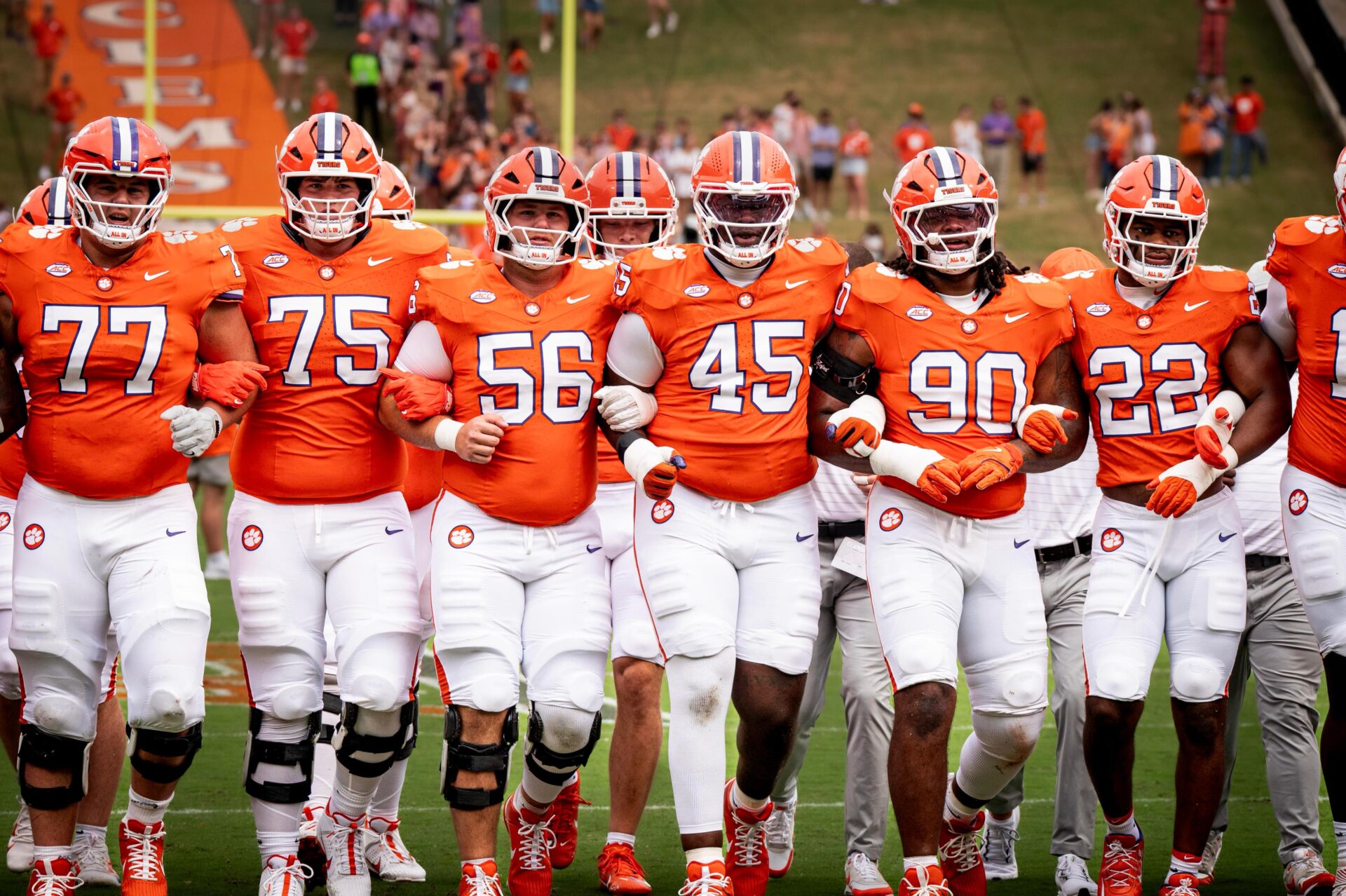
CLEMSON, S.C. — For almost thirty years, there was exactly one answer to who ran the weight room at Clemson. Joey Batson had the job since 1997, longer than most of this year’s roster has been alive, and the program built around him became as much a part of Clemson’s identity as the rock or the hill. Batson retired in January. And for the first time since Bill Clinton’s first term, somebody else is in charge of getting Clemson’s strength program.
That somebody is Dennis Love, and he isn’t pretending the assignment is small.
“Coach Batson, like I said, he’s put the stamp on the program,” Love said. “I got a chance to work with him for like 11 years, so I kind of know how it’s been done.” That familiarity doesn’t make the job easier. “Just to live the life of Coach Batson, it’s going to be hard,” Love said. “He’s a man of honesty, integrity, just love the kids. But just to be back here working for him, I know that I got some big shoes to fill. And just working hard to make sure that I make him proud of me.”
Love isn’t new to the building. Eleven years at Clemson the first time around, 2004 to 2014. The last four of those running strength and conditioning for the school’s Olympic sports programs — baseball, men’s soccer, women’s volleyball. Then he left. Two years with the Denver Broncos, on the staff that got a roster to Super Bowl 50. Four years at Purdue, associate director of football strength and conditioning. A stop at Auburn in 2021. Then Clemson came calling again, and he came back in January 2022 as an assistant under Batson, the guy who’d mentored him the first time through. Four more years learning the program from the inside before it became his to run.
That backstory matters for understanding what’s actually different in the weight room this year, because Love isn’t walking into Clemson as an outsider trying to prove a point. He’s a Cheraw, South Carolina native who already knows these kids and has the relationships. Now he’s building his own version of a program he helped run for years under someone else. Ask him what he wants this team to be, physically, and the answer isn’t about max numbers on a bar. “Detailed, disciplined, and just be a team,” Love said. “Strength is definitely the foundation, but it’s going to all be how you express that strength. So when you’re detailed and disciplined and working with a purpose, it’s going to allow you to express that strength that’s needed.” He wants players to understand the reasoning, not just follow the program. “When they understand the why, they’re going to work harder at the how,” he said, “and then that’s when I say the purpose comes with it.”
The first time they ran it, according to Love, defensive back Corian Gipson nearly blacked out and refused to stop. “The first day we ran the Dykes, I think Corian almost passed out, but he would not quit,” Love said. “So I would say he set that tone day one, and that’s kind of the standard that everybody’s been following.” Love also singled out Sammy Brown and Ashton Hampton as players whose training age and work ethic have stood out early. It’s not a complicated concept, running a hill. It’s just hard, in the specific and public way that builds something a weight room rep alone never quite does.
Then there’s the part of the program that has nothing to do with hills at all. Love introduced what’s become known around the building as the squat party, an idea he borrowed from a coach named Jeff Pittman at a previous stop. “I liked the energy that it brought, team camaraderie,” Love said. “It’s good when guys have the set time of the year that they train, 6:30 in the morning, 8 o’clock, 9 o’clock, but all of a sudden you throw a curveball for 9 and just call it a squat party. You’ve got neon lights and smoking DJs and things like that. It kind of makes a change of the norm, and the guys get fired up about it.” Asked afterward who actually won the thing, Love didn’t hesitate. “There was not an official winner. I would say Clemson.”
None of that means much on its own. Neon lights don’t win November games. But the timing lines up with something else Swinney has been saying all offseason without much prompting: that this Clemson team is faster, at literally every position, than the one that took the field a year ago. That’s a specific and checkable claim for a coach to make in July, the kind that either shows up on tape by October or gets brought back up as a promise that didn’t hold. Love’s own numbers back up part of it. He pointed to running back Chris Johnson Jr., the Miami and SMU transfer, as a case study, a player who came in already fast and got faster under the new program. “I think we got him at a 4.38 when he first got here, now he’s at a 4.24,” Love said. “But Chris Johnson has really bought into the program, whether that’s doing what he needs to do inside the session or doing extra outside the session.”
That kind of individual jump matters more this year than usual, because Clemson is absorbing more than 20 early enrollees and freshmen into the program at once, according to Love, and turning a high school body into a college one doesn’t happen on a single timeline. “The first thing, when they first get here, we make sure that we assess them so we can see where they really are,” Love said. New arrivals get pulled away from the upperclassmen for roughly two weeks while the staff teaches them the technique and the rhythms of how the room operates before folding them back in. “We just make sure we don’t push them too quick so they’re not getting overwhelmed and they can develop at a pace that will allow them to be successful.”
A handful of those freshmen have already caught Love’s attention. Receiver Juju Preston came in dealing with an injury and needing real work in the weight room, and Love says the turnaround has been obvious. “Juju’s made some tremendous strides,” Love said. “He’s one of those 4.3 guys coming in, and now he’s lifting, bulletproofing that body so he can withstand a big, powerful season.” Defensive back Polo Anderson, out of Dorman High School, has drawn similar praise. “He’s advanced,” Love said. “He’s really moving some weight with the upperclassmen. He’s got a lot of upside to him. Great attitude, great mindset. He never complained about anything.”
There’s a version of a coaching change that’s really just a name swap, same program, new guy signing off on the same sheets. This isn’t that. Batson’s system worked for a long time, long enough that changing it at all was a real decision, not a formality. Swinney didn’t have to promote from within to protect continuity. He could’ve hired outside, brought in someone with no history at Clemson to shake things up on paper. Instead he handed the keys to someone the roster already trusted, then let that coach start making changes anyway. Dike Runs came back. Squat parties got invented. The identity of the program stayed recognizably Clemson while the specific ways it gets enforced started looking like Dennis Love’s version of it instead of Joey Batson’s. Love even frames the team’s whole mentality shift in hunting terms. “These guys are really buying into being a hunter,” he said. “That’s what I’m telling them, let’s go hunt.”
Whether any of it shows up in the record book is a different question, one nobody in Clemson’s building can answer in July. Conditioning gains are notoriously hard to prove before the games start counting, and a hot summer of hill sprints has never guaranteed a healthier defensive tackle room in November. But programs that talk about culture shifts usually mean something specific by it, even when the specifics sound small from the outside. A hill nobody’s run in years. Music in the weight room now. A running back whose 40 time dropped over a tenth of a second. And a strength coach who almost left for the NFL and chose to stay, mostly because he couldn’t find anywhere else that felt like this.
Fall camp will start putting that bet to the test soon enough.