
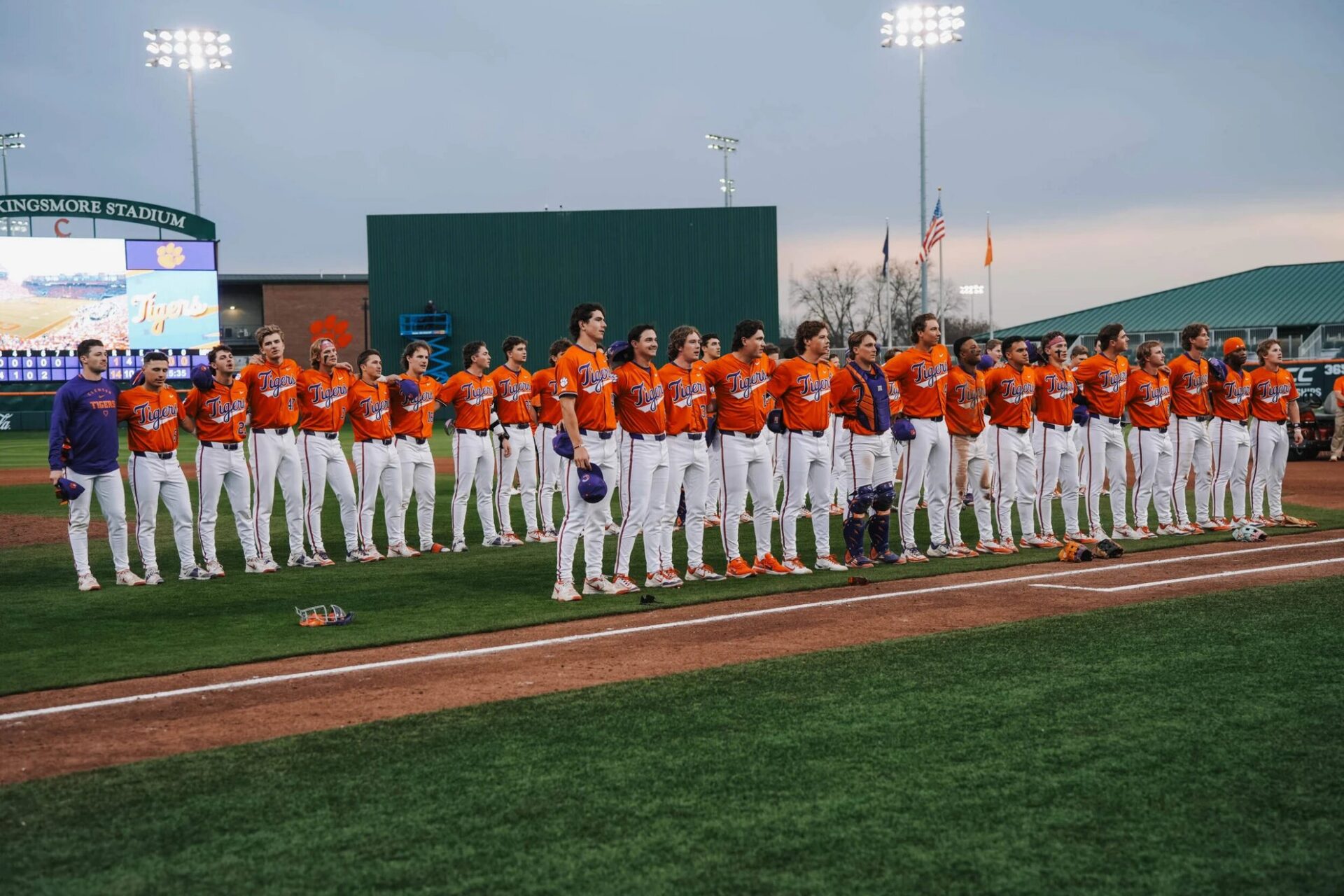
The Tigers had the talent. They had the moments. What they didn’t have was the ability to sustain either when it counted.
Notre Dame 5, Clemson 4. Three solo home runs, one walk, twelve strikeouts. A season that began at 15-2 ended on a Tuesday afternoon at Truist Field in Charlotte, in the opening round of the ACC Tournament, with the tying run somewhere between second base and the batting cage. As I wrote after the ACC Tournament loss, the season was likely over before the last out. It just took the scoreboard to confirm it.
The final record: 31-27 overall, 10-20 in ACC play. Fifteenth seed. One and done. Clemson headed to Charlotte knowing no 15th seed had ever survived the ACC Tournament format. The Tigers didn’t break that streak.
If you only looked at the first six weeks, you would have picked this team for 40 wins. If you only looked at the last four months, you would have wondered how it won 31 at all. Both versions are accurate. That is the problem.
The Talent Was Never the Question
Nate Savoie hit .329 with 16 home runs and 52 RBI, playing all 57 games. Jacob Jarrell hit 18 home runs and drove in 50, earning All-ACC honors. Jarren Purify slashed .344 in 40 games. Luke Gaffney hit .318 with 43 RBI. Tryston McCladdie stole 20 bases and knocked in 47.
Michael Sharman went 6-2 with a 3.39 ERA and 88 strikeouts in 73 innings as the Friday starter. Ariston Veasey held opponents to a .143 batting average over 20 appearances. Two freshmen, Brendon Bennett and Danny Nelson, made the All-ACC Freshman Team.
This roster had legitimate contributors at every position and enough pitching depth to compete on most weekends. The names on the stat sheet do not explain a 10-20 conference record. Something else does.
The ACC Exposed Every Weakness
Clemson went 21-6 in non-conference games. In ACC play, the record flipped to 10-20. That is not a small gap. That is a different team.
The Tigers handled business early, going 15-2 before their first ACC series. The offense looked alive. The pitching looked sharp. Then Notre Dame came to town for the first conference series, and the Tigers got swept. Georgia Tech came to Doug Kingsmore, and Clemson dropped two of three at home. Miami came in, and the Tigers lost the series. Virginia on the road: two of three losses. Louisville on the road: a sweep, all three games close, all three losses.
The pattern never changed. Get runners on. Strand them. Fall behind in the middle innings. Rally late. Come up short. Repeat.
The Boston College series in early May laid it bare. In the opener, Clemson went hitless with runners on base and fell 8-4. The Tigers left runners in scoring position in every inning from the third through the seventh. The next day, the offense showed up in a 14-4 rout, Clemson’s biggest offensive inning since 2005 powering the blowout. That was the season in two games. One day, nothing with runners on. The next, everything. Never any consistency.
Against Louisville in late April, Clemson left 17 men on base in the series finale, a 7-5 loss in 10 innings that completed the sweep. The Tigers had the go-ahead run at third in the fifth, runners at second and third in the sixth, and went 0-for-5 with runners in scoring position before the third inning ended. Jimmy Nugent hit two home runs for the Cardinals. Clemson hit plenty of balls hard. None of them found grass when it mattered.
That series was the season. Not because it was the worst loss, but because it offered the clearest picture of what kept going wrong. Clemson could get on base. It just could not do anything with runners in scoring position against conference pitching.
The Clutch Problem Wasn’t Bad Luck
There is a difference between a team that gets unlucky and a team that cannot execute in high-leverage moments. Luck evens out over 30 conference games. What happened to Clemson in ACC play was a trend.
The Tigers went 2-for-13 with runners in scoring position in the Boston College series opener. They went 4-for-14 with runners in scoring position against Florida State and still lost. In the Notre Dame tournament game, they drew one walk and struck out 12 times. Three of their four runs came on solo home runs. The rest of the lineup produced nothing with men on base.
Over the course of the season, Clemson’s at-bats got worse as the situation got more important. Strikeout rate climbed. Walk rate dropped. That is not a scouting problem or a talent problem. That is an approach problem, and it showed up in every meaningful series the Tigers played.
One Reliable Starter Wasn’t Enough
Michael Sharman gave Clemson a chance every Saturday. His 3.39 ERA and .243 opponent batting average over 73 innings anchored the staff. He struck out 88 and walked 11.
Behind him, the rotation rotated. Aidan Knaak, the most talented arm on the staff, finished 2-6 with a 5.81 ERA. He struck out 91 in 57.1 innings, which tells you the stuff existed. It also tells you he could not find the zone when it mattered, walking 28 and giving up 11 home runs. Dane Moehler went 0-3 with a 5.94 ERA in 10 starts.
The bullpen outperformed the rotation behind Sharman. Veasey, Simmerson, Bennett, and Nelson all posted ERAs under 4.00 and held opponents under .230. But a bullpen can only do so much when the starter gives up four runs in four innings on a consistent basis.
The Louisville Sweep Killed the Season
Point to one weekend that ended Clemson’s postseason hopes, and it is the trip to Jim Patterson Stadium on April 24-26. The Tigers arrived at 26-14 overall and 6-15 in the ACC. They left at 26-19 and 6-18.
Friday: 13-10, five errors turning a competitive game into a blowout. Saturday: 11-6, the offense showing up but the pitching not holding. Sunday: 7-5 in 10 innings, Clemson rallying to tie it in the ninth only to watch Jimmy Nugent end it with a walk-off two-run homer.
Three games. Three losses. All of them close enough to win. None of them won.
The Tigers went 5-10 the rest of the way. Even a late three-game winning streak that included an 11-run first inning against Boston College and a road win at No. 7 Coastal Carolina could not close the gap. By the time Clemson got to Charlotte, winning the ACC Tournament was the only path to the NCAA field. No 15th seed has ever survived that.
What This Season Actually Was
This was not a collapse. A collapse happens when a good team falls apart. This was a team that played like a top-tier club for six weeks against a soft non-conference schedule and like a bottom-tier club for the next four months against the ACC.
The 15-2 start came against Army West Point, Bryant, Presbyterian, Charlotte, La Salle, and Michigan State. The 10-20 conference record came from an inability to execute in high-leverage moments against better pitching. The truth sits in the middle. Middle-of-the-pack roster. Top-tier results for six weeks. Bottom-tier results for four months.
Erik Bakich enters his fifth year with most of the core returning. Savoie, Jarrell, Purify, McCladdie, and Gaffney are all eligible to come back. Bennett and Nelson showed enough as freshmen to build around. The talent remains in the building.
But talent is not what kept this team from the postseason. Execution is what kept it out. Approach is what kept it out. The ability to deliver a hit with a runner in scoring position in the seventh inning of a one-run ACC game is what kept it out. Until that changes, the roster will not matter.
The 2026 Clemson Tigers had enough to finish better than 31-27. They just never figured out how to play better when it counted.