

On January 14th, Dabo Swinney broke one of his more unpopular traditions, and finally made a massive hire from outside of the Clemson program. Former Penn State Defensive Coordinator Tom Allen was brought in, marking what was not only one of the largest moves in college football, but what could prove to be one of the most monumental decisions in Dabo’s tenure.
Clemson ranked 69th in total defense last season (allowing 374 yards per game) and 85th in rushing yards allowed (giving up 160 yards per game). Their four losses to Georgia, Louisville, South Carolina, and Texas can largely be attributed to flaws in run defense, especially in regards to tackling and gap discipline. Isaac Brown, LaNorris Sellers, and Jaydon Blue running through the Tigers defense like a greasy stick of butter coated in baby oil seriously faulted the team’s ceiling in 2024, and Tom Allen hopes to be the missing piece that brings Clemson back to title contention.
From a philosophical standpoint, it seems Allen has already earned the trust of his fellow coaches and players. The Clemson community has bought into what he brings to the game, and he’s shown a willingness to pour himself into the program for seasons to come. For more information on his coaching philosophy and cultural impact, check out our article “Tom Allen Brings Energy, Accountability, and Edge to Clemson Defense.” Here, we’re going to focus more on the tactical element of Allen’s coaching. In order to best understand what he brings to the table, one must have a solid understanding of the Wes Goodwin defense (4-3 base) and how it relates to Tom Allen’s (4-2-5 nickel) defense. Let’s dive in.
The 4-3 is largely considered to be the most popular defense in all levels of football. Brought by Hall of Fame Coach Tom Landry, the defense features four defensive lineman (two on the interior, two defensive ends), three linebackers (Mike, Sam, Will), and four in the secondary (two boundary corners and two safeties). The defense typically boasts traditional roles at all positions, with the three tech defensive tackle arguably being the most important.

One of the main strengths of the 4-3 defense is its ability to stop the run. The formation is incredibly gap sound, meaning it accounts for nearly every rushing angle an offense would attempt to take advantage of. However, when you have your entire front seven accounting for different rushing lanes, it provides limited support for missed tackles. This became one of Clemson’s two glaring weaknesses last season. PFF graded Clemsons tackling a 70.8 last year, 59th in the country, the worst we’ve seen in the last ten seasons. Arm tackles, overpursuit, and simply poor form allowed for rushers to break free for massive gains that at times handed Clemson a painful loss. A defense with a more “bend don’t break” mindset (we’ll get to what that looks like in a second) is much more advantageous when tackling is that problematic.
One weakness of the scheme is it’s not incredibly friendly against modern spread offenses. With the formation being half a century old, offenses have had plenty of time to exploit its faults, and has found that putting the SAM and WILL linebackers in coverage with faster, more athletic pass catchers has proved successful. High-flying, air raid offenses can tear up the 4-3, something we’ve seen time and time again historically. This has led to a constant re-tooling of the scheme, adding new alignments, patterns, and methods of execution, which brings us to the biggest issue the Tigers faced with the formation last season:
It’s just too damn complicated.
At least, it was too complicated for former defensive coordinator Wes Goodwin. Some fifty years ago, the 4-3 was simply the “default” defense of football. Nearly every team at the top of the game boasted the formation, and the nuance came from complex deviations and variations of the scheme. Because of this, the formation is simultaneously the most traditional as well as the most convoluted in the sport. It’s somehow both living in the past but too advanced for its players. It’s simple for a coach, but complicated for the athletes, the opposite relationship you strive for in football. Ideally, you want a formation that can be understood and executed by the players, while also allowing the coaches the creative flexibility to showcase their knowledge of the game.
Under Tom Allen, the defense expects to take a massive shift. Allen is implementing the 4-2-5 nickel scheme, which is much more favorable for Clemson at this time. The 4-2-5 is the brainchild of the 4-3 and the 3-3-5. It shows four defensive lineman, two linebackers, and five in the secondary. The defense typically only keeps six in the box, as opposed to seven with the 4-3. This style allows teams to be effective against the run, and sets them up astronomically better against the pass.
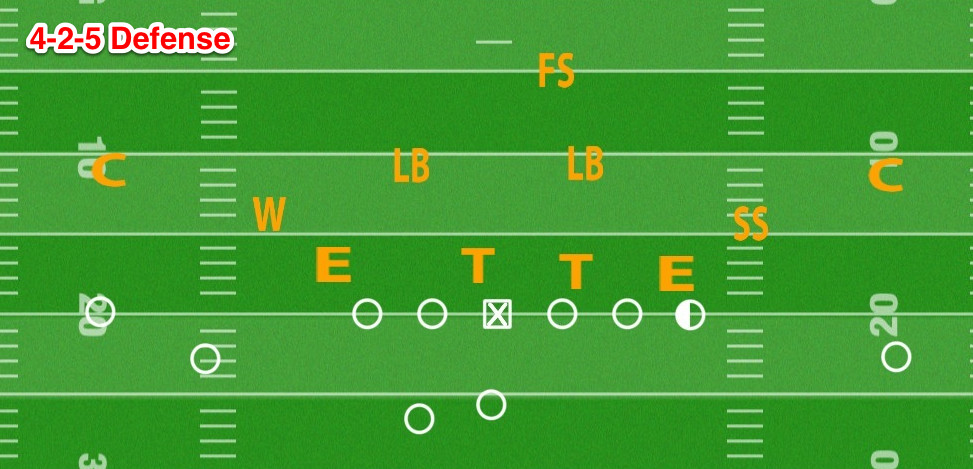
The main strength of the 4-2-5 is it proves effective against the same spread offenses that ruin the 4-3. It does so for a beautifully simple reason; there’s an extra defender in the secondary. Simply replacing a run stopping, gap filling linebacker with a slot corner or a third safety can do wonders to combat the spread out, high flying air raid attack you see in today’s game. Additionally, there is no coverage you can’t run with the 4-2-5.
Now, obviously, the front seven (now six) is slightly limited with one less in the box. This may seem like it makes the defense worse in the run game, but that’s not necessarily accurate. Instead of requiring the linebackers to fill in a lane, they are tasked with not letting ball carries behind them. This may allow for some small gains throughout the game, but prevents those breakaway runs we saw Clemson allow far too often in the 2024 season.
Finally, the most amazing element of the 4-2-5 is that it allows for limitless creative expression. I mentioned earlier that the 4-3 is so complex for the players while remaining simple for the coaches. The 4-2-5 is the opposite. It brings everything you want out of a player-coach relationship in football. The coaches can use their exceptionally tactical minds to explore copious different coverage disguises and blitz packages. At its purest form, the formation inherently features some form of disguise coverage, with one EDGE rusher given the ability to either rush the passer or drop into coverage. Having a player with a task masked to the offense is inherently a headache for opposing teams, and that’s just the shallow beginning of what this scheme is capable of.
While the formation is plenty complex for the coaches, it’s also remarkably simple for its players. Athlon Sports said it best, stating; “Allen describes himself as a ‘big concepts guy’ who prioritizes simplicity for his players, allowing them to play with confidence and speed. The multiplicity in his system comes from the coaching staff’s ability to adjust, not from overloading players with complex schemes.” The formation caters to the strengths of the players, and successfully masks any weaknesses. Players that can’t quite be a full time defensive end or coverage linebacker are perfect EDGE rushers for this system. Slower, more traditional run stopping linebackers work beautifully with their safe, stable tackling vision. Secondary players don’t necessarily have to be boundary corners or deep safeties, and can do their job in taking up space, flying at the quarterback in certain blitz packages, and defending slot receivers, tight ends, and running backs out of the backfield. The scheme is so ridiculously fluid it allows for intelligent coaches to identify and capture the strengths of their players while effectively masking the weaknesses.
Clemson’s defense has all the talent to be the best in college football, and may have acquired the most intelligent defensive coordinator in the game. This combination has proved lethal for the Tigers in the past, and fans should be excited for what’s to come in the fall.


